Curating Your Personal Space: How Your Environment Steals (or Saves) Your Energy
Your living space should reflect your unique story and hold the things that matter most to you. Discover how to shape an environment that truly feels like home.
Walk into your room right now. What’s the first thing you notice? Is it a pile of clothes on the chair, a cluttered desk, or a space that actually makes you exhale a deep breath of relief the second you look at it?
Most of us don’t realize it, but we spend hours trying to protect our energy from the outside world, completely ignoring the fact that our physical spaces are quietly feeding energy back into us. When your room, your desk, or your living space is an absolute mess, your mind never really gets a chance to shut down. It’s like having twenty different browser tabs open in your brain at the same time, all running in the background and draining your battery. That is why learning the art of curating your personal space isn’t just some trendy interior design hobby for Instagram—it’s an act of self-preservation. It is about building a physical boundary between the chaos of life and your own mental peace.
Why Your Environment is Secretly Dictating Your Mood
Let’s be completely honest with each other. Have you ever sat down to work or relax, only to find yourself getting inexplicably irritated, distracted, or heavy-hearted, all because the room around you was cluttered?
There’s actually a deep psychological reason for that. When your surroundings are messy, your brain has to work overtime just to filter out all that visual noise. Psychologists refer to this as cognitive overload. Every single unwashed mug, every pile of stray clothes, and every disorganized corner acts like a tiny, silent to-do list screaming at the back of your mind: “Fix me! Clean me!” Even when you aren’t actively looking at the mess, your nervous system registers it as unfinished business.
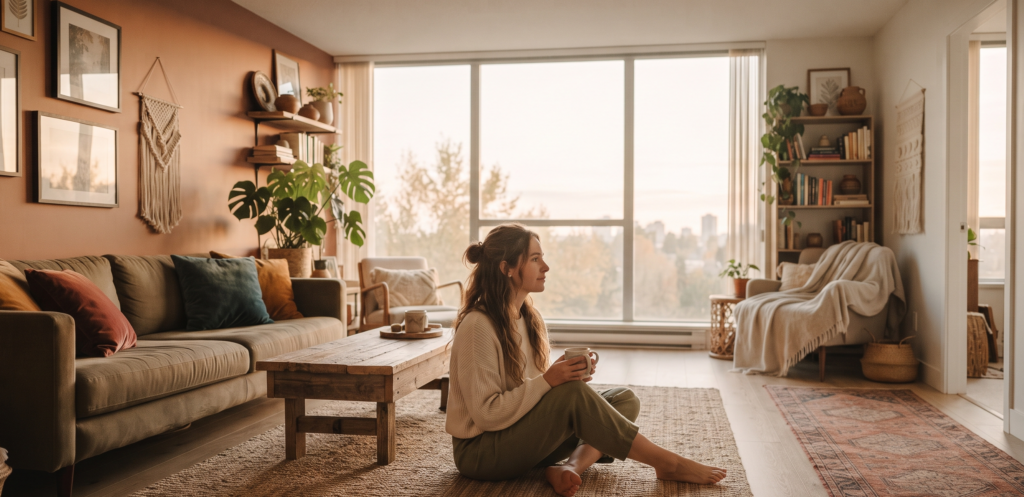
That is why you can feel completely exhausted in a room full of clutter, even if you haven’t actually done any physical work. But the moment you start curating your space—stripping away the excess and keeping only the things that serve a real purpose or bring a genuine sense of comfort—something incredible happens. The mental static clears out. You stop fighting your environment, and for the first time all day, your surroundings actually start supporting you instead of draining you. And once you experience that shift, you realize that cleaning up isn’t a chore anymore; it’s a way of clearing a path for your own sanity.
The 3 Golden Rules of Curating Your Space (Without Spending a Fortune)
Now, I know what you might be thinking. Does curating a space mean buying expensive aesthetic furniture, throwing everything away, or spending thousands of dollars on a total home makeover? Absolutely not. Real curation has nothing to do with a big budget and everything to do with intentional choices. You can completely change the feeling of a room using just three simple, grounded steps:
1. The “Edit, Don’t Just Clean” Rule
Most people think they are organizing when they are actually just moving clutter from one spot to another—shoving things into drawers, stuffing closets, or hiding messes behind closed doors. That’s not fixing the problem; that’s just sweeping it under the rug. Curating means taking a step back and acting like an editor for your own life. Walk through your room, pick up items, and ask yourself a hard question: Does this item actually belong in the chapter of life I am living right now? If an object only brings back heavy memories, serves no practical purpose, or is just taking up physical space because you felt guilty throwing it away, it’s time to let it go. When you clear out the physical weight of things you’ve outgrown, you naturally make room for fresh energy to step into your daily routine.
2. Designate a “High-Vibe” Sanctuary Zone
Trying to transform an entire house or apartment all at once is a fast track to burnout. You end up overwhelmed, surrounded by half-empty boxes, and giving up halfway through. Instead, pick one small zone. Maybe it’s a cozy reading chair by the corner of the window, a clean writing desk where you plan your creative projects, or simply your bedside table. Focus all your energy on making that single spot an absolute sanctuary. Keep work papers, random electronics, and clutter completely away from this zone. Fill it with things that ground you—a nice candle, a notebook that inspires you, or just an open space to breathe. Once you establish even a single corner of your home that feels entirely safe and peaceful, you’ll find yourself naturally gravitating toward it whenever the rest of the world feels a little too loud.
3. Lighting Changes Everything (More Than You Think)
If you want to kill the cozy, peaceful vibe of a room instantly, turn on a harsh, bright overhead white light. It makes your living space feel like a corporate office or a hospital waiting room, keeping your nervous system on high alert. One of the easiest, cheapest ways to curate your space is to completely rethink your lighting. Turn off the big overhead lights in the evening and switch to warm, layered lighting. Use a small bedside lamp, soft fairy lights, or even a couple of warm-toned candles. The moment you soften your lighting, your body physically reacts—your breathing slows down, your shoulders drop, and your brain finally gets the signal that it is safe to unwind. It’s a tiny physical adjustment, but it completely transforms how a room feels the moment you step inside.
Finding Your Balance in the Spaces We Create
At the end of the day, your personal space is nothing less than a physical mirror of your inner world. If your room is chaotic, fragmented, and overflowing with things you don’t even care about, your mind will naturally mirror that exact same restless energy. But you don’t need a massive interior design budget or a complete life overhaul to change it.
You just need to decide that your peace of mind is worth more than holding onto clutter. Start small. Pick one messy corner today, clear out the noise, soften the lights, and notice how much lighter you feel when the walls around you are finally working with you, not against you.
Because when your space feels right, everything else in your day starts falling into place a little bit easier, too.